
The Threat / Arousal Pattern

Updated: Oct 4
Week 3 of the Symptom Patterns Series
When fear and heightened alarm dominate the symptom picture — and why symptoms alone cannot identify the cause.
What You Notice
During benzodiazepine withdrawal, some people go through periods when fear and alarm seem to dominate everything else. There may be dread without an obvious reason, a feeling of being constantly braced for danger, or difficulty settling even when no clear external threat is present.
The body may feel activated at the same time. A racing heart, trembling, muscle tension, poor sleep, internal restlessness, or sensitivity to sound and stimulation may appear during the same period.
This can feel frightening because the symptoms may seem to come from both the mind and the body at once.
Recognizing the Threat / Arousal Pattern
The Threat / Arousal Pattern is a descriptive way to name a symptom picture in which fear, alarm, vigilance, and difficulty settling are especially prominent.
Symptoms may include:
fear or dread
feeling braced for danger
hypervigilance
panic-like surges
racing heart
trembling or inner shaking
muscle tension
poor sleep
internal restlessness
sensitivity to sound, light, or stimulation
No single symptom defines this pattern. The same symptoms can also appear in other patterns or for reasons unrelated to withdrawal.
How This Differs From the Hyperarousal Mode
Earlier articles described withdrawal "modes," including hyperarousal. A mode describes the lived state of the nervous system — what it feels like when the system is on high alert.
A symptom pattern is slightly different. It describes how symptoms from several functions appear together in the current clinical picture.
For example, a person may feel fear and alarm, sleep poorly, notice a racing heart, feel tense, and become sensitive to stimulation during the same period. The pattern does not mean all of those symptoms have one cause. It means they are appearing together in a recognizable way.
Why These Symptoms Are Difficult to Interpret
Fear, alarm, panic-like surges, racing heart, poor sleep, and difficulty settling are real symptoms. But they are also nonspecific.
Similar symptoms can occur in several situations, including withdrawal-related arousal, rebound, recurrence of an underlying condition, continuing symptoms from the original reason the medication was used, stress, sleep loss, medical illness, medication effects, endocrine changes, or other contributors.
This is why symptoms alone cannot determine the explanation. A threat/arousal picture can be recognizable without being diagnostic.
Four Explanations That Can Overlap
Several explanations may need to be considered.
Withdrawal-related arousal means symptoms appear in relation to dose reduction, stopping the medication, medication changes, or sometimes the interval between doses.
Rebound means a symptom for which the medication was originally used returns, sometimes temporarily more intensely than before.
Recurrence means the underlying condition returns over time.
Continuing or other symptoms means the original problem may never have fully resolved, or other physiologic and contextual factors may be contributing.
These explanations are not always cleanly separate. Rebound can overlap with withdrawal-related change. Symptoms that recur predictably between doses may provide useful timing information, but even that pattern is not diagnostic by itself.
Information That May Add Context
Several details may help place the symptoms in context:
relationship to a dose reduction, missed dose, medication change, or stopping the medication
timing between doses
how the current symptoms compare with the person's pre-benzodiazepine baseline
whether the symptom picture includes unusual sensory or perceptual features
how the symptoms evolve over time
None of these features proves the cause on its own.
Some comparative studies suggest that certain sensory or perceptual symptoms may be more characteristic of withdrawal than ordinary anxiety. They are not present in everyone, and their presence does not establish a diagnosis. Their absence does not rule withdrawal out.
What This Pattern Can — and Cannot — Tell Us
Recognizing this pattern may help explain why emotional and physical symptoms can appear together. For example, fear or dread may appear alongside a racing heart, trembling, muscle tension, poor sleep, and internal restlessness.
But the pattern does not establish that:
withdrawal is the only cause;
anxiety recurrence is the only cause;
every symptom has the same mechanism;
the person belongs to a fixed subtype;
medication should be changed based on the pattern alone.
The goal is not to label the person. The goal is to organize the symptom picture carefully enough to discuss it.
Why Medical Context Still Matters
New, severe, changing, or unusual symptoms always deserve appropriate medical evaluation. A racing heart, chest symptoms, severe agitation, faintness, neurological symptoms, or major sleep disruption should not be assumed to be withdrawal without considering other causes.
A pattern can help describe what is happening. It cannot replace clinical judgment.
Connection to the Five-Axis Stress Biology Framework™
Five-Axis Stress Biology Framework™, this picture is interpreted as one in which symptoms linked to CRH/Adrenergic Stress (Axis 1) are especially prominent.
Symptoms involving autonomic regulation, sleep, motor tension, sensory sensitivity, and internal restlessness may appear alongside it. This does not mean that one axis explains the whole picture.
"CRH/Adrenergic Stress" is a framework description, not a measured biomarker in an individual patient. Human benzodiazepine-withdrawal studies have not demonstrated a specific Axis 1 mechanism for this pattern.
Transition to the Autonomic Pattern
Autonomic symptoms, such as a racing heart, sweating, dizziness, nausea, or temperature changes, may appear alongside threat and arousal. But in some people, internal-body regulation symptoms become the most prominent part of the picture.
That is the focus of the next article: the Autonomic Pattern.
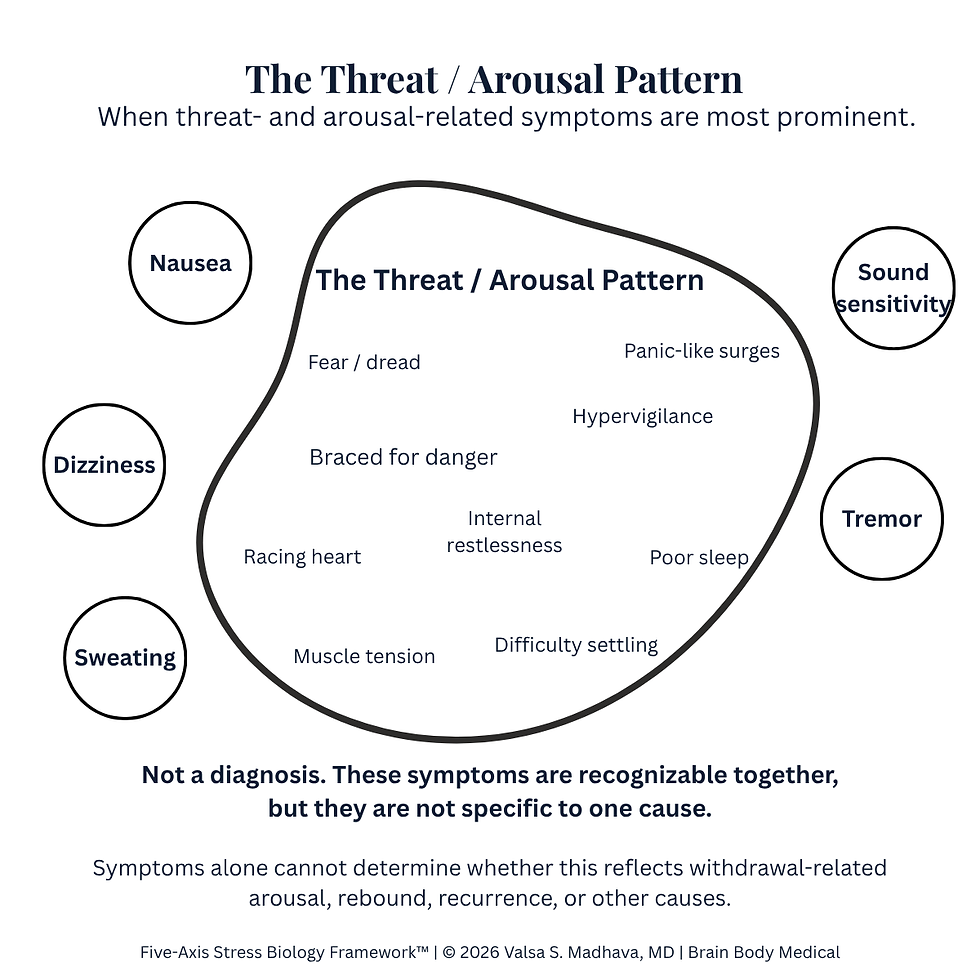
Figure 3. The Threat / Arousal Pattern
This figure illustrates a symptom picture in which fear, alarm, body activation, poor sleep, and internal restlessness appear together. The figure is descriptive. It does not show that all symptoms have one cause, that one system causes another, or that the person belongs to a fixed subtype.
About the Evidence
The patterns in this series are provisional educational descriptions informed by published withdrawal literature, the author's own exploratory cross-sectional analysis of 39 patients,
Five-Axis Stress Biology Framework™, and clinical observation.
The 39-person analysis supports the existence of overall non-random, overlapping symptom organization. It does not validate any particular named pattern.
The Threat / Arousal Pattern is not a diagnosis, fixed subtype, or proven mechanism.
Symptoms of fear and arousal are nonspecific and can have multiple possible explanations.
The available evidence does not establish whether such symptoms reflect withdrawal, rebound, a returning condition, continuing original symptoms, or a combination. These descriptions do not replace individual medical evaluation, and medication changes should not be made on the basis of them alone.
Selected Scientific References
Allison, C., & Pratt, J. A. (2003). Neuroadaptive processes in GABAergic and glutamatergic systems in benzodiazepine dependence. Pharmacology & Therapeutics, 98(2), 171–195. https://doi.org/10.1016/S0163-7258(03)00029-9
Ashton, H. (1991). Protracted withdrawal syndromes from benzodiazepines. Journal of Substance Abuse Treatment, 8(1–2), 19–28. https://doi.org/10.1016/0740-5472(91)90023-4
Cantopher, T., Olivieri, S., Cleave, N., & Edwards, J. G. (1990). Chronic benzodiazepine dependence: A comparative study of abrupt withdrawal under propranolol cover versus gradual withdrawal. British Journal of Psychiatry, 156, 406–411. https://doi.org/10.1192/bjp.156.3.406
Lu, D., Uldry Lavergne, C. G., Choi, S., Park, J., Kim, J., Zhao, S., Desimone, Q., Lendaro, E., Chen, B., Han, B.-X., Wang, F., & Goldstein, N. (2024). General anesthesia activates a central anxiolytic center in the BNST. Cell Reports, 43(11), 114909. https://doi.org/10.1016/j.celrep.2024.114909
Pétursson, H. (1994). The benzodiazepine withdrawal syndrome. Addiction, 89(11), 1455–1459. https://doi.org/10.1111/j.1360-0443.1994.tb03743.x
Shade, K. N., et al. (2025). Long-term neurological consequences following benzodiazepine exposure: A scoping review. PLOS ONE, 20(8), e0330277. https://doi.org/10.1371/journal.pone.0330277
Tyrer, P., Owen, R., & Dawling, S. (1983). Gradual withdrawal of diazepam after long-term therapy. Lancet, 1(8339), 1402–1406. https://doi.org/10.1016/S0140-6736(83)92355-3
Mechanistic references, including Allison & Pratt (2003) and Lu et al. (2024), are cited to support biological plausibility. They are not evidence that a specific threat/arousal mechanism has been demonstrated in human benzodiazepine withdrawal. The comparative perceptual-symptom statement draws on Tyrer et al. (1983) and Cantopher et al. (1990); such symptoms may be more characteristic of withdrawal in some comparisons, but their presence is not diagnostic and their absence does not exclude withdrawal. The Series 4 organizational analysis is the author’s own exploratory analysis, is in preparation for publication, and has not yet been externally replicated.
Five-Axis Stress Biology Framework™ | © 2026 Valsa S. Madhava, MD | Brain Body Medical
For educational purposes only. Not a substitute for individual medical evaluation.


